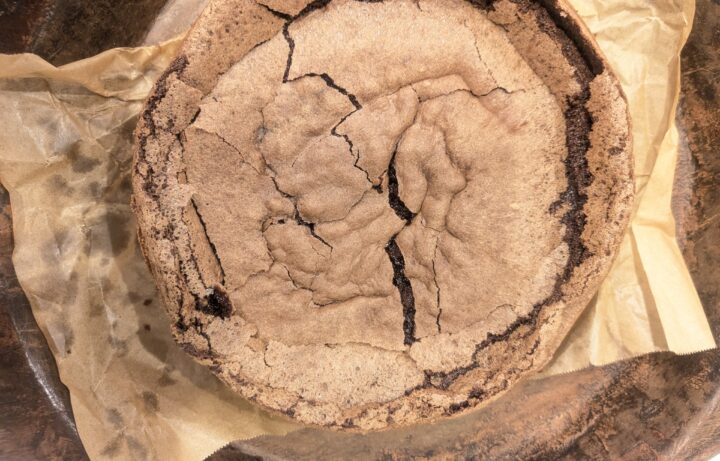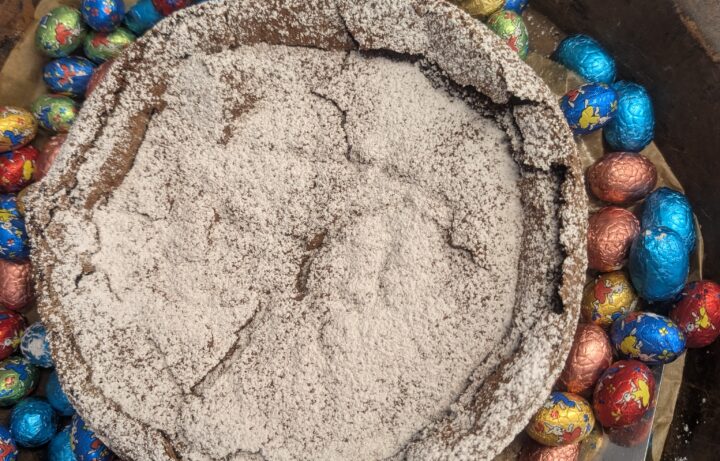
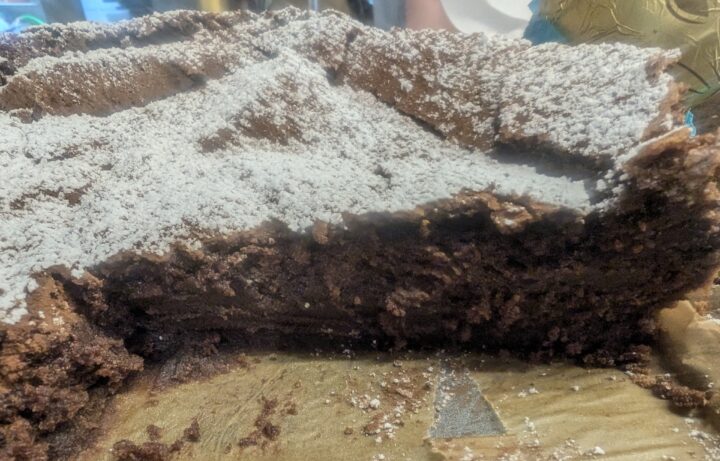
This is the updated version of a recipe I have made many times — what was a chocolate espresso cake is now a tray bake slice, with two small but meaningful technique changes that lift it from very good to genuinely brilliant. Rich, fudgy, and flourless, built on a base of dark chocolate, butter, and almond meal — it has a dense, truffle-like centre with a delicate cracked crust, and it just happens to be gluten free. The slab format means cleaner slices, easier serving, and a thinner ratio of cake to crust so every bite has that delicate crackled top.
The changes are about flavour and texture. The cocoa now gets bloomed in hot espresso before it meets the chocolate — bloomed cocoa tastes like proper dark chocolate, while raw cocoa added at the end has a dusty, slightly bitter edge. The almond meal gets blitzed with the sugar in a high-speed blender until ultra-fine, which solves the gritty mouthfeel that comes with even the best supermarket almond meal. Both changes take an extra two minutes. Both are worth it.
CHOCOLATE ESPRESSO SLICE
Ingredients
- 200g good-quality dark chocolate, chopped
- 200g unsalted butter
- 25g cocoa powder
- 30ml hot espresso (or 1 tsp instant coffee dissolved in 30ml boiling water)
- 8 large eggs, at room temperature
- 165g granulated sugar (for the almond meal)
- 165g caster sugar (for the eggs)
- 120g almond meal
Method
- Preheat the oven to 160°C. Grease a 20x30cm slab tin and line with baking paper, leaving overhang on the long sides as handles to lift the slice out later.
- Make the flavour paste. Melt the 200g dark chocolate and 200g butter together in a heatproof bowl over a saucepan of simmering water, or in the microwave in 30 second bursts, stirring until smooth. Meanwhile, in a small bowl, whisk the 25g cocoa powder into the 30ml hot espresso until you have a smooth, glossy paste. Stir this paste into the melted chocolate and butter until fully combined. Set aside to cool to room temperature (20–25°C). This step is non-negotiable — folding warm chocolate into whipped eggs will deflate the foam and you will lose the lightness the cake depends on. Cool means cool, not lukewarm.
- Why bloom the cocoa? Cocoa powder is dehydrated chocolate solids and on its own has a dusty, slightly raw quality. Whisking it into hot liquid releases the flavour compounds properly and rounds out the bitterness. Combining bloomed cocoa with melted dark chocolate gives a deeper, more rounded chocolate flavour than either ingredient alone.
- Make the ultra-fine almond flour. Pulse the 120g almond meal with the 165g granulated sugar in a high-speed blender or food processor until the mixture is very fine — about 30 to 40 seconds, in short bursts so the almond meal doesn’t release oil. Sieve through a fine mesh strainer, throw out the lumps. The result should feel like icing sugar between your fingers.
- Why granulated sugar, not caster? Granulated sugar has bigger, harder crystals than caster, which act like grinding stones against the almond meal in the blender. Caster sugar is too fine to do any real grinding work — it just powders up. This is borrowed from macaron technique, where the same principle gives you that famously smooth shell.
- Whip the eggs. In a stand mixer fitted with the whisk attachment, whip the 8 eggs on high speed until they begin to turn pale and expand — about 2 minutes. With the mixer running, trickle the 165g caster sugar in slowly, in a steady stream over about 30 seconds. Continue whipping until the mixture is thick, pale, and falls in ribbons that hold their shape briefly on the surface — another 3 to 4 minutes.
- Why caster sugar for the eggs? Caster’s small crystals dissolve quickly into the eggs without weighing the foam down. Granulated sugar would take longer to dissolve and might compromise the foam structure. Adding sugar after the eggs have started to foam (not at the start) builds a more stable structure that holds up to the heavy chocolate fold.
- Combine. Pour the cooled chocolate-espresso paste over the whipped eggs. Using a large metal spoon or spatula, gently fold through — under and over, turning the bowl as you go. Don’t stir. The aim is to keep as much air in the eggs as possible while incorporating the chocolate. Once the chocolate is almost fully through, sprinkle the sieved almond-sugar mixture over the top and fold through until just combined and no streaks remain.
- Bake. Pour the batter into the prepared tin and gently spread to the corners with a spatula. Bake on the middle shelf for 30 to 35 minutes. The slice should rise and form a delicate cracked crust on top, but the centre should still wobble slightly when the tin is shaken gently. Do not use a skewer test — this is a fudgy slice, not a sponge, and a skewer will always come out with crumbs even when it is perfectly cooked. Trust the wobble.
- Cool and slice. Cool in the tin on a wire rack for at least 30 minutes — the slice continues to set as it cools. Use the paper handles to lift it out onto a board. Cut into squares with a sharp knife, wiping the blade clean between cuts for tidy edges. About 20 generous squares.
Notes
Why a tray bake instead of a round cake? A round cake of this batter sets thicker, which means longer baking, a drier edge, and the centre being slightly underdone if you pull it too early. A tray bake gives you a more even thickness, faster cooking, cleaner slicing, and squares that are easy to serve straight from the tin. It also looks more impressive on a platter than a sliced wedge.
On the chocolate. Use the best you can. I usually have Callebaut on hand — the 70% gives you a serious dark chocolate slice, the 55% (Callebaut 811 or similar) gives a milder, more crowd-friendly result. Cadbury Old Gold or Plaistowe Dark work too. Don’t use cooking chocolate compound — it has vegetable fat in place of cocoa butter and the flavour is flat.
Storage. The slice keeps in an airtight container in the fridge for up to 5 days. Bring squares to room temperature for 15 minutes before serving for the best texture. It also freezes brilliantly — wrap individual squares and thaw in the fridge overnight, or eat straight from the freezer for a fudge-like, almost ice-cream consistency.
Serving suggestions. A light dusting of cocoa followed by a snow of icing sugar is all this needs — the icing sugar settles into the crackled top and looks like fresh snow on dark earth. For something more special, drizzle warm dark chocolate ganache over the cooled slab before cutting. A dollop of barely sweetened whipped cream or crème fraîche on the side, and a strong coffee.
For Easter. Scatter mini chocolate Easter eggs across the centre of the cooled slab — the cracked surface holds them like little nests. Cut around them when serving so each plate gets a few.