
If you’ve got a lime tree you know the problem: come Spring and Summer, you’re drowning in fruit. One week there’s a handful on the branches, the next week there’s enough to fill a bucket, and by next week the tree’s completely overloaded and you are sending visitors home with bags of limes, and the next week there’s a box full near the letterbox with a sign “free limes”. Rather than let them rot on the ground or resign yourself to juicing them all or putting loads of limes in the freezer, here are three interesting ways to preserve the glut—each one completely different, each one useful for something entirely different. A cordial for the slushie machine, a fermented drink that carbonates naturally, and a tangy depth-builder for the pantry. Pick one or do all three; you’ve got the time and the fruit.
WHEN LIFE BRINGS YOU LEMONS OR LIMES
LIME CORDIAL
The easiest preserve: juice the limes, add sugar, shake daily until it dissolves, done. No boiling, no fuss, just juice and sugar creating a shelf-stable concentrate you can dilute straight into the slushie machine or pour over ice and a bit of tequila and triple sec or white rum and a bit of soda, if it’s too bitey, is quite a nice drink. It’s cleaner than anything you’d buy and takes about ten minutes of active work.
Ingredients
This assumes you have a 2 litre container, use less but keep to the proportions – this is a bit tart so makes great margaritas but for kids, or use as a cordial increase the sugar to 1:1. It will be more shelf stable at a higher sugar concentration.
- 1100ml fresh lime juice
- 800g white sugar
- NOTE: A quarter teaspoon of citric acid per litre of cordial will extend shelf life and brighten the flavour, particularly useful if you’ve reduced the sugar, but definitely not necessary.
Method
- Pour lime juice into a clean bottle or jar, (Old wine bottles are also good)
- Add sugar.
- Seal and shake vigorously for 1–2 minutes.
- Leave on the bench, shake frequently on day one or once or twice daily until it is completely dissolved.
- Sugar will fully dissolve within 2–3 hours of total shaking time (roughly 5 vigorous shakes spread through the first day).
- Once dissolved, transfer to storage. Store in a cool cupboard or fridge; will keep at least 2–3 months at room temperature, longer if refrigerated.
Serving suggestions
Use half the bottle in your Ninja slushie machine, top up with water to the fill line, and freeze. You’ll get at least two full machines from one bottle. Pour straight over ice for a cordial drink, or add to sparkling water for a quick refresher. If making for kids, dissolve extra sugar into it to sweeten further—the base recipe is deliberately light on sugar so it doesn’t cloy. For a margarita just add 2 shots tequila and one of triple sec. Works really well if using the slushed mix.
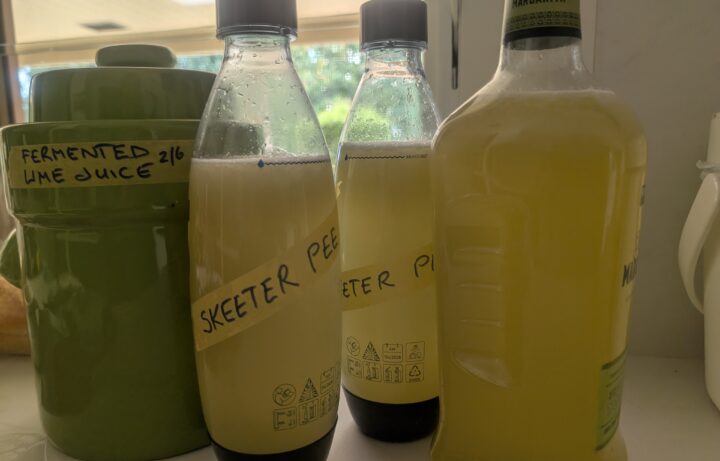
NOT REALLY SKEETER PEE – FERMENTED LIME
This is not hard liquor, just natural wild fermentation doing its thing with juice and sugar, sealed in a bottle, shaken daily until natural yeasts in the juice create carbonation and a subtly funky, tangy flavour. It’s sweet-tart, fizzy, and tastes a little like cordial— but more like a naturally fermented lemonade that happened to be made from limes. Zero additives, and genuinely interesting, and may not work – but for us, after about a week we were getting slight fizz and interesting taste. Really easy to make – just do a couple of bottles, leave for a bit , drink then make a couple more bottles, again good with the same ingredients above.
Ingredients
These are the volumes for a soda stream bottle that copes well with carbonation, which is what we are aiming for. It should fill to the wiggly line on the bottle which allows for space for carbonation.
- 560ml fresh lime juice
- 280g white sugar
Method
- Pour lime juice into a clean SodaStream bottle or similar pressure-rated bottle.
- Add sugar.
- Seal and shake well. Add a label and record the date is was made.
- Leave at room temperature (not in direct sun), shake daily.
- After 3–5 days, you’ll notice the bottles get a bit hard and there is a slight fizz when you open them. It is best to leave sealed and let it continue fermenting.
- By 1–2 weeks, it should be noticeably fizzy. Taste at this point—if you like the level of carbonation and flavour, move to cool storage (cupboard or fridge) to continue slow fermentation. If you want more fizz, leave it another week.
- Will develop more flavour and fizz over time; drink within 2–3 months.
- Tastes like a very adult cocktail, but its not alcoholic. It wouldn’t be hard to make it that way though.
Serving suggestions
Serve chilled, straight from the bottle over ice. It’s a finished drink, not a cordial—pour and enjoy. The sugar and fermentation mean it’s sweet enough on its own, with natural carbonation doing the work. If it’s too tart or you want a long drink, you can top it with a splash of water or sparkling water and load up the ice. Tastes excellent in a margarita.
SALT-FERMENTED LIME JUICE
Pure lacto-fermentation: juice, salt, time, and the natural bacteria in the juice do the work. After 2–4 weeks you’ve got a tangy, funky, deeply savoury condiment that adds fermented depth to almost anything—cook with it, use it in sauces, add it to dressings. This is your depth-builder and pantry staple, shelf-stable without refrigeration.
Ingredients
This fits in a Mad Millie water seal fermenting jug, adjust quantities to suit the container. If you don’t have a fermenting jar what you have will need to be burped daily.
- 2500ml fresh lime juice
- 75g salt
Method
- Pour lime juice into a clean fermentation jar (water-seal jar recommended).
- Stir in salt until completely dissolved.
- Cover loosely or seal with a water-seal lid if using one.
- Leave at room temperature, out of direct sun.
- Fermentation will be visible after 3–5 days: slight cloudiness, a few bubbles, a tangy smell.
- Taste after 2 weeks. The longer it sits, the more complex and funky the flavour becomes. At 2 weeks it’s mildly tangy; at 4 weeks it’s deeply savoury with fermented funk.
- When you’re happy with the flavour, seal it or transfer to storage bottles. Will keep indefinitely at room temperature in a sealed jar.
Serving suggestions
Use it as you would a fermented condiment—a splash in soups and stews for depth, in dressings and marinades, in sauces where you’d normally use lemon juice but want something with more character. It’s particularly good with Asian dishes, seafood, and anywhere you want fermented tang without fresh citrus. A little goes a long way.
Notes
All three preserve your lime glut in completely different ways. The cordial is straightforward and useful; the Skeeter pee is a fermented drink and genuinely interesting; the salt-fermented is a pantry workhorse. Start with the cordial if you want something guaranteed to work. The fermented versions need only patience and basic hygiene—they’re safe as long as you keep them clean and covered.
If your limes are particularly acidic (which they usually are), the cordial can handle it; the Skeeter pee will be slightly tarter but still pleasant; the salt-fermented will develop complex acidity that actually works in your favour. None of these are fussy. They’re all designed to work without special equipment or skills.