
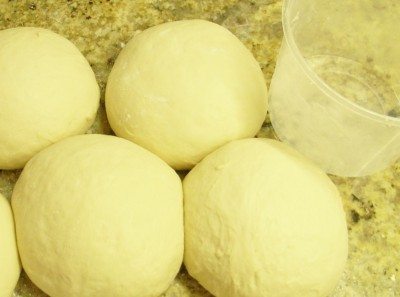
Pizza dough rolled after initial mixing
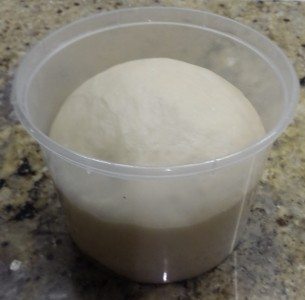
Pizza dough in container, ready for the fridge or left out if needed the same day.
WOOD FIRED PIZZA DOUGH
After years of wood fired pizza nights and plenty of dough experiments (including molasses, sourdough and kefir versions), this is the one we keep coming back to. Plain baker’s flour, a small amount of yeast, an overnight cold ferment in the fridge — nothing fancy, and the long slow rise does all the flavour work for you. One batch makes eight 200g balls, enough for eight thin-crust pizzas around 25–27cm across.
We cook these in a wood fired pizza oven where the fire is in a separate chamber and the heat comes up through the stone base. The dough handles the full range of oven temperatures well — crisp base, light chew, good edge. See our wood fired pork recipe for what to do with the oven once pizza night is done.
Ingredients
- 1kg white baker’s flour (900g to start, 100g reserved in a separate bowl — 50g for bench dusting, 50g to add during kneading if needed)
- 620g lukewarm filtered water, weighed (plus 30g extra in a small container, set aside to use if necessary)
- 20g olive oil
- 20g fine salt
- 3.5g dry yeast (weigh on a microscale – half a 7g pack)
- Molasses and sourdough starter (optional – see notes
Method
- Weigh and measure everything before you start. Have the 900g flour, 100g reserved flour (50g for dusting, 50g for adjusting), 620g water, 30g extra water, salt, oil and yeast all lined up beside the mixer. I have a standard scale and a micro scale for the salt and yeast, just a bit more accurate.
- Put the 900g flour, salt and yeast into the mixer bowl. Whisk together with a Danish dough whisk until evenly combined.
- Add the water and olive oil to the bowl. Use the Danish dough whisk to bring everything together into a rough shaggy dough — about 30 seconds. Make sure there’s no dry flour left at the bottom of the bowl.
- Fit the dough hook to the mixer. Mix on slow speed for 1–2 minutes until the dough looks evenly combined.
- Cover and rest 20 minutes. A damp tea towel over the entire mixer or even plastic wrap on the top of the bowl will do.
- Mix slowly for 5 minutes, stopping once to scrape down the sides. The dough should start coming together and pulling away from the sides. If it looks dry and is riding up the hook, mix for another minute or two first — the flour often catches up on its own. Only add the reserved water if it still looks dry after that. If it looks wet and sloppy, add the reserved flour a spoonful at a time.
- Increase to speed 3 and knead another 2 minutes until the dough is smooth and elastic.
- Tip onto a floured bench and shape into a log, flour dust the top. Cover with plastic wrap or a tea towel and rest another 20 minutes. (time to clean up the mixer)
- Divide into 8 pieces of around 200g on the scales. Roll each piece into a tight ball, tucking the edges under.
- For small batches, lightly oil 8 round takeaway containers with lids and drop a ball into each. For larger batches, use a flat container with a lid (flat wide and short storage containers with a lid work well): lightly oil each ball, dust with flour, and space them about 3cm apart in rows so they have room to double overnight. Close the lids and put straight into the fridge.
- Leave overnight, or up to 48 hours — flavour actually improves with the longer rest. Take out 2 hours before you need them so they come up to room temperature.
Making the base
- On a floured board, push the dough out using the side of your hand, rotating as you go. Once it starts to spread, lift it up and gently stretch it by holding the outer edges and letting gravity do the work.
- Sprinkle semolina on an upturned pizza tray and lay the base on top. Don’t work it any more once it’s on the tray.
- Add passata and toppings quickly and straight into the oven. The longer the dressed base sits, the soggier it gets.
Notes
Flavour boost — for a deeper, harder-to-place complexity that plain pizza dough lacks, add 10g blackstrap molasses to the water and 30g leftover sourdough starter to the flour. The starter doesn’t need to be active or recently fed — even dried-out leftover starter from the fridge works, because it’s the organic acids you want for flavour, not the rise. Everything else stays the same — same hydration, same 24-hour cold ferment, same shape and bake. The molasses doesn’t read as sweet and the starter doesn’t read as sourdough; what you get is a base that tastes like it has a story. The 3.5g commercial yeast still does the lifting. This is best with a full 48 hour cold ferment to let the flavour develop.
Yeast quantity — instant yeast is sold in 7g sachets in most supermarkets. The 3.5g per batch means one sachet does two pizza nights with no leftover.
Hydration: Flour absorbs differently between brands and batches. Have the reserved flour and water beside the mixer so you can adjust. The dough should be soft and slightly tacky, coming away from the sides of the bowl but not looking dry.
Equipment tips: A Danish dough whisk saves getting out the paddle attachment just to combine the dry ingredients. A longer S-shaped dough hook (different from the standard KitchenAid spiral) keeps the dough down in the bowl rather than riding up under the collar — worth having if you make this often.
Yeast: 3.5g may look light, and it is deliberately so. With 24 hours in the fridge the yeast has plenty of time to work slowly. Too much yeast on a cold ferment and the dough over-proves, gasses out, and the containers blow their lids overnight.
Scaling up: Don’t double the mix in a standard KitchenAid — it can’t handle more than 1kg of flour comfortably. For a crowd, make multiple single batches back-to-back.
Freezing: Balls freeze well straight from the fridge. Defrost in the fridge overnight, then 2 hours on the bench. Don’t use the microwave.
Leftover dough: Surplus balls make excellent dinner rolls, a small tin loaf, or baguette-style garlic bread — see our sourdough focaccia for another direction this kind of dough can take or, if they have been out and risen completely the best thing to do is par cook and freeze them with pieces of baking paper between them. Make a base, lightly oil with garlic infused oil, use a dirk to put holes in the dough then cook at 300°C for 90 seconds, cool on a rack then freeze. To use, put toppings on the frozen pizza base and cook in a pre-heated, very hot oven.