
It is difficult to understand why anyone would buy bright yellow thickened gloop with a shelf life measured in years when this takes about ten minutes and tastes like actual fruit. Lemon, lime, mandarin — whatever your tree is throwing at you right now — the method is the same. Made in a high-speed blender with a thermometer, there’s no double boiler, no stirring for 20 minutes, and no lumps. Don’t be put off by the quantity this makes; citrus butter freezes perfectly for up to a year, so make a big batch at peak season and pull out a jar whenever you need it. We put a dollop on our breakfast mix and in protein smoothies to help mask the whey flavour.
We grow lots of different types of citrus trees, partly because they grow easily, have few bugs and are easy to manage and partly because I just love fresh citrus straight from the tree. You do not get mandarins or tangelos or indeed any citrus from shops that have the tang that comes from freshly picked fruit.
I keep the trees reasonably small, pruning off the leaf miner, removing crossed branches and keeping the centres from becoming too crowded keeps the trees manageable, and in our area able to be netted. During the day the cockatoos steal the fruit, sit on the fence, eat out the seeds and throw the rest of the fruit on the ground and at night we have visits from fruit bats and possums. I have found that the fruit trees need to be netted fairly early in the season, before the fruit is ripe, because once the cockatoos have found a food tree they become very persistent and insistent and anything short of steel netting and razor wire will not entirely protect the crop.
Regular mulching, feeding and consistent watering provides us with virtually all of our citrus. If it’s not in season in our garden we tend not to buy it because they taste so much better from our trees.
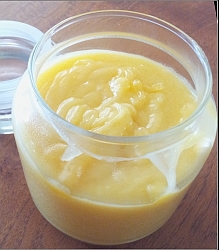
CITRUS BUTTER WITH OPTIONAL FINGER LIME PEARLS
This is the most amazing, soft, tangy, mousse like lemon curd you will ever make and it is all about how the ingredients are treated. If you don’t have a high speed blender, the type that actually heat the food through sheer strength, then you won’t achieve the results, the ingredients still make a nice lemon curd but to get the mousse texture there needs to be plenty of air incorporated.
This curd would taste fabulous in a tart or a layer in cheesecake. The whole eggs mean it is quite pale, the vanilla masks the “egginess” but the process is where the magic happens.
Ingredients
Makes approximately 4 x 500ml jars.
- 12 whole eggs
- 450g white sugar
- 150g butter, cut into chunks and warmed/melted in a jug
- 550ml fresh warmed, citrus juice (lemon, lime, mandarin, or a combination) in a jug
- Zest of your chosen citrus, finely grated (optional)
- 1 tbsp Molino vanilla extract – or similar
- Finger lime pearls from 6–8 finger limes (optional)
Method
- Add the 12 eggs and 450g to the Vitamix, start on medium and gradually increase to high speed. After 2–3 minutes the mix will be pale and creamy and the sugar will be dissolved. The jug is beginning to warm. Check the temperature.
- At about 60°C add the 150g butter and blend until combined.
- Add the 550ml warmed citrus juice and 1 tbsp vanilla. Continue blending until the mixture reaches around 60–70°C — the juice going in cold will drop the temperature so it is fastest to warm it in the microwave. If you can’t get all the juice in set it aside and add when it is moved to the saucepan. This will depend on how much air is incorporated in the blender.
- Pour the mix into a large, wide, saucepan over low heat. Stir constantly, scraping the bottom and sides, while the mixture thickens and coats the back of a spoon — a finger drawn across the back leaves a clear line. Target temperature is 80–84°C. the thermometer rules here. Keep warming and stirring until the 83°C
- Remove from the heat and stir to ensure everything is smooth. If using zest stir it in immediately so the oils release into the warm mixture.
- If using finger lime pearls, cut finger limes in half lengthwise, scrape out the pearls and stir them into the curd. Stir gently — do not blend or heat further as the pearls will collapse.
- Pour the mix back into the blender jug or any other jug and fill the jars to 1 cm from the top. You can use a ladle but it is slow and messy.
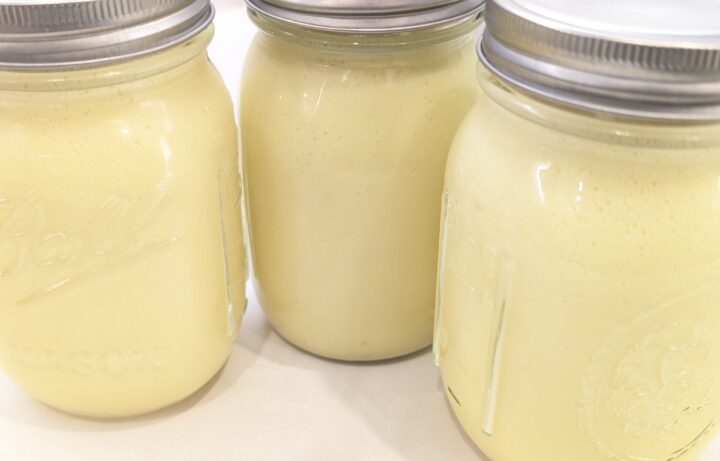
- Seal and cool before refrigerating one jar for immediate use and freezing the rest. Don’t forget to label them – I use masking tape!!
Notes
Freezing: Citrus butter freezes well for up to 12 months. Freeze in small jars or vac sealed bags, 200–250ml is ideal — so you can defrost just enough for a week’s use or a single recipe. Thaw overnight in the fridge. If it weeps slightly on thawing, a quick stir brings it back together.
Which citrus: Lemon gives the sharpest, most classic result. Lime is more floral and slightly more bitter. Mandarin is sweeter and milder — reduce sugar by 20g if using mandarins as the juice is naturally sweeter. A combination of lemon and mandarin works well if you want brightness without full tartness.
Zest: Use a fine micro-plane and take only the coloured part of the skin — the white pith underneath is bitter. Zest before juicing.
Finger limes: The pearls are delicate and collapse with heat, which is why they go in last. They add a burst of tart juice and a striking visual. Finger limes are seasonal — the curd is still excellent without them.
Eggs: The extra yolks (versus using all whole eggs) give a richer, more stable emulsion. The leftover whites freeze well or can go to the dogs or added to smoothies or even make meringue.
Uses: Spread on toast, scones, or crumpets. Fill tart shells. Swirl through yoghurt or cream. Use as a cake filling or flavouring in a cream cheese cheese-cake, add to smoothies – helps with the taste of whey protein powders, have on breakfast seed mix, even think about a lemon curd margarita (YUM).
Great work mum! love it.