
Labneh is a soft fresh cheese made simply by draining the whey from salted yoghurt. I make it with my own thick and creamy yoghurt, usually at the end of the week when the last of the batch has already drained itself thick. It’s a great spread on crackers, Mountain bread or toast topped with cucumber, tomato, capsicum and basil, makes a savoury spread with garlic, and mixed with egg and ras el hanout gives a more contemporary curried egg. It also packs down much smaller than a tub of yoghurt, so we make a big batch to take away on holidays. It is used as a spread for bread, topping for cracker biscuits (top with tomatoes, gherkins etc) and on breakfast cereal as yoghurt. It takes up far less space than a tub of yoghurt, is a lot healthier than butter and can be used as a thickener in salads and vegetable dishes.
LABNEH AND STRAINED YOGHURT
Ingredients
- 1kg full-fat plain yoghurt, homemade or bought (partly strained is fine)
- ½ tsp fine sea salt
- Optional flavourings: finely chopped lightly fried onion, crushed garlic, chopped parsley or garlic chives
Method
- Stir the ½ tsp salt through the 1kg yoghurt, along with any flavourings you are using.
- Line a fine sieve with a double layer of muslin (a clean triangular bandage works well). Sit the sieve on egg rings inside a larger bowl so it stays well clear of the whey as it drains.
- Spoon in the yoghurt, then gather up the corners of the cloth and tie them into a bag. Twist the knot to gently squeeze the bag, and tighten it again from time to time as the whey drains.
- Leave in the fridge for about 24 hours, pouring off the whey occasionally, until the labneh is fairly firm.
- Turn out into a container and store in the fridge.
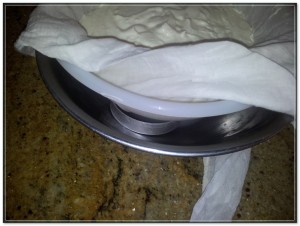
Mesh basket over egg rings
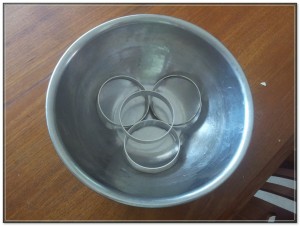
Egg rings in bowl
STRAINING
- Put the mixture into a muslin cloth – I line a seive with a double layer of triangular bandage, I have lots of triangular bandages from first aid courses that I have attended over the years. Lately I have been lining a fine seive with the muslin and sitting it on egg rings inside a bigger steel bowl. I gradually make a bag of the cloth by pulling up the corners and tieing them. This is gradually tightened up by twisting the knot.
Other things to try:
- Tie the bag through a wooden spoon and hang it through a rack on the fridge over a bowl to catch the liquid.
- Use a lined funnel shaped seive in the top of the empty 2kg Greek yoghurt container which does a good job.
- Leave for about 24 hours to drain away the whey. I do this in the fridge but others leave it out to drain.
- When it is fairly solid put it into a container and store in the fridge. It keeps for over a week.
Other uses
- Use it in cucumber raita or tzatziki, as the yoghurt marinade in Tandoori chicken – anywhere you don’t want that “too runny” yoghurt consistency.
Thickened yoghurt – quick
- This can be made in an hour or less – whatever time is available – and is a good way to treat yoghurt when it is being added to a salad or a sauce.
- I have a very fine seive, into this I scoop about 1 1/2 times the amount of yoghurt that I am going to need in my recipe and suspend it over whatever bowl it fits over.
- Leave it for as long as possible to drain out the whey, pouring it off from time to time, while doing the rest of the food prep. The yoghurt thickens quite well as it drains.
Lemon yoghurt sauce
- To the thickened yoghurt add 1/2 tsp salt (if using the unsalted quick version), juice of 1/2 lemon and some chopped capers or poor mans’ nasturtiums.